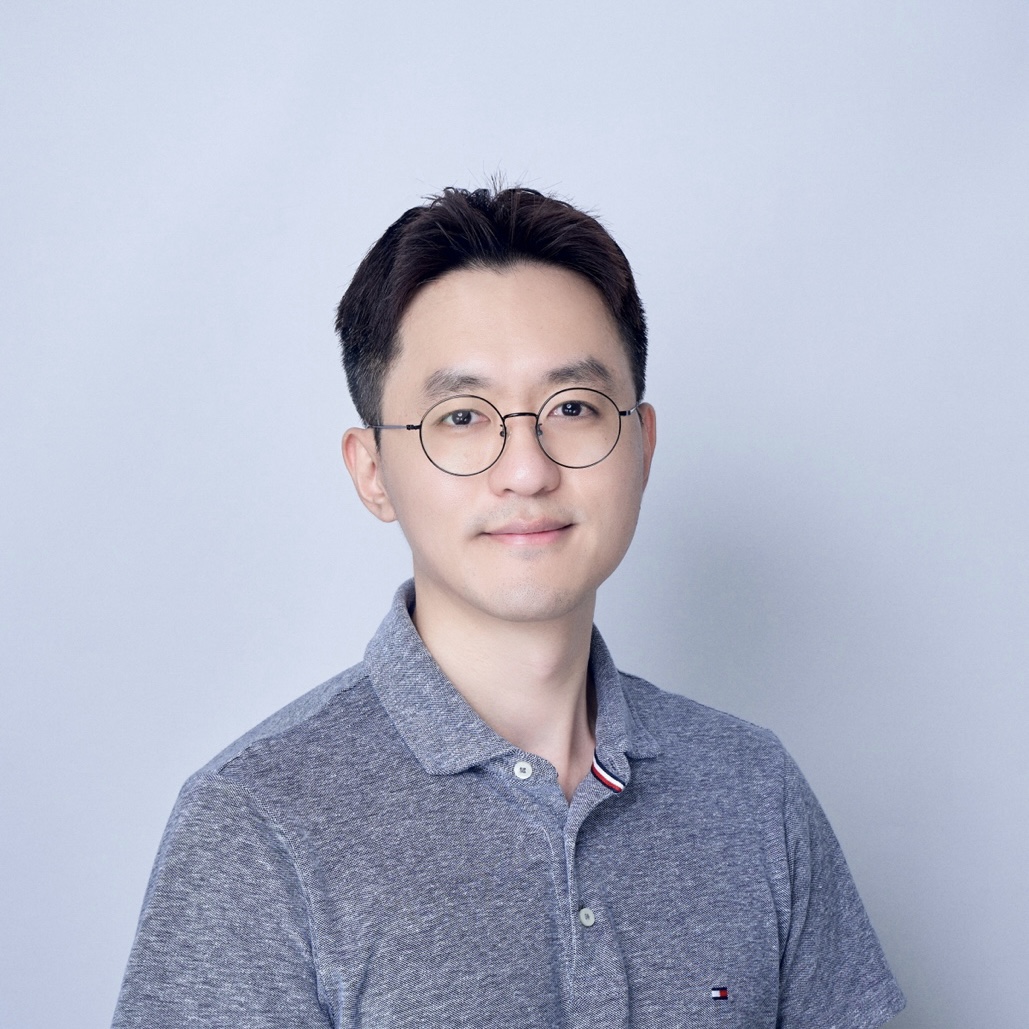
Senior Applied Scientist Amazon AGI

Byeonggeun Kim

I lead research on audio representations and generative models at Amazon AGI.

My current work focuses on fully causal neural codecs for full-duplex speech-to-speech systems: representations that support both speech understanding and generation while balancing audio fidelity, latency, and language-model predictability.

Portrait of Byeonggeun Kim

At Amazon AGI

Current and recent work.

  1. Full-duplex speech-to-speech

    I lead codec research for full-duplex models, owning architecture, training, implementation, and cross-team integration. Matched-training comparisons showed gains in speech recognition, generated-speech intelligibility, and human-rated voice quality over an acoustic-only codec, and successive designs are adopted in internal speech-to-speech models.

  2. Audio and music generation

    I led design and training of an RVQ-based autoregressive audio/music generator for Amazon Nova 2 research, from data preparation and delay-pattern decoding to delivering the recipe for larger multimodal models.

Selected research

Representative publications.

All publications
01

Generative audio ICML 2025

Streaming audio generation with continuous-valued tokens

Continuous-valued audio tokens avoid the fidelity loss of discrete tokens, but are hard to generate causally, token by token, as streaming requires. I proposed masked next-token prediction (MNTP), a training task that brings continuous-audio fidelity to causal, token-by-token generation.

Result
AudioCaps FAD 33% lower than AudioGen Large.
Role
Proposed MNTP; primary research mentor.
02

Audio representations ICASSP 2025 · Oral

Single-stage audio encoder pretraining at scale

Leading self-supervised audio encoders such as BEATs rely on iterative pretraining, which is costly to scale. I led the design of a single-stage alternative with curriculum masking and scaled it to 400K hours of audio.

Result
Outperformed a reproduced BEATs baseline on all five frozen-encoder probes at matched model and data scale.
Role
Co-first author; led design and training.
03

Efficient neural architectures INTERSPEECH 2021

BC-ResNet: broadcasted residual learning

On-device keyword spotting needs tiny models, yet cheap 1D temporal convolutions lose the frequency structure that 2D convolutions keep at a much higher cost. I co-developed broadcasted residual learning, which keeps most computation temporal, and proposed its auxiliary 2D residual path, which preserves frequency information.

Result
BC-ResNet-1 matched TENet12's Speech Commands v1 accuracy with 10.9× fewer parameters and comparable compute.
Role
Co-first author.
04

Domain generalization DCASE 2021 · Task 1A

DCASE 2021 Challenge Winner

Task 1A asked for low-complexity acoustic scene classification across multiple recording devices. Looking past model compression, I identified frequency-dependent device shift as the key barrier and proposed Residual Normalization, which reduces device effects while preserving scene cues.

Result
1st place; log loss 0.724 vs. 0.758 for the runner-up team.
Role
First author of Qualcomm's winning submission.

Recent

News.

  1. Our INTERSPEECH 2026 oral paper on fine-grained feedback from audio-aware LLMs for text-to-audio instruction following is on arXiv.

  2. Invited talk at Yale University (CPSC 7760): Efficient and High Fidelity Text-to-Audio Generation: From Parallel Decoding to Causal Streaming.

  3. Two papers accepted at ICML 2025: continuous-valued audio language modeling and IMPACT.